FinOps for Digital Transformation

Hybrid Cloud
Cloud Transformation
IT Transformations
Digital transformation makes organisations faster, more agile and more innovative. Yet every CFO and CIO has sat through this meeting: The cloud bill has come in higher than budgeted, again, and no one can quite explain why. Engineering points to new features shipped, finance points to a lack of visibility, and the business asks the question everyone would rather avoid: are we actually getting value for this spend?

This isn't an IT problem or a finance problem. It's a governance problem—and the answer is FinOps.
14 July 2026 minute read

Executive Summary

Public cloud, SaaS and modern licensing models are powerful engines for innovation and rapid scaling. They enable organisations to deploy capabilities faster, experiment at lower cost, and respond dynamically to changing business needs.

However, these same capabilities fundamentally change the nature of technology spend. Costs become variable, decentralised, and fast-moving—often outpacing traditional governance mechanisms.

Without proper controls, pay-as-you-go consumption can lead to unexpected cost increases, limited visibility and unclear accountability. Traditional approaches such as purchase order approvals are no longer sufficient in an environment where resources can be provisioned instantly and continuously.

FinOps addresses this challenge. It introduces financial accountability into business consumption, mitigates the business risk, and maximizes the business value of every euro spent. By enabling timely and data-driven decision-making, FinOps allows organisations to control costs and unlock innovation.

FinOps should be implemented as both an operating model and a cultural practice: aligning engineering, finance, procurement and leadership around transparency, accountability and continuous optimisation.

Cloud and SaaS need FinOps


Digital transformation programs accelerate the adoption of Cloud platforms and SaaS solutions. Cloud provides on-demand access to scalable and configurable resources that can be rapidly provisioned and released. SaaS delivers standardised capabilities with fast deployment, low upfront investment, reduced maintenance overhead, and flexible subscription-based pricing.

These models offer clear advantages:
  • Faster time-to-market
  • Greater scalability and flexibility
  • Lower barriers to experimentation and innovation
  • Reduced operational complexity

However, the same properties that enable speed and flexibility also introduce financial risk: Consumption-based pricing and decentralised purchasing make it easy for costs to grow unnoticed. Without proper allocation, visibility and ownership, organisations struggle to answer fundamental questions: Who is driving spend? What value does it deliver? Where should we optimise?

As technology spend becomes distributed across teams, credit cards, and vendor marketplaces, the lack of control can lead to:

  • Budget overruns and financial unpredictability
  • Erosion of trust between business, finance and technology teams
  • Reduced confidence in digital transformation initiatives
  • Missed opportunities to optimise and reinvest
FinOps restores control by making technology spend transparent and actionable. By allocating spend to value streams and business owners, FinOps creates accountability. By providing timely and accurate insights, it enables informed decision-making. And by aligning finance, technology, and operations, it ensures that every investment in technology is linked to measurable business outcomes.

The FinOps playbook


Our Finops framework is built around three continuous phases: Inform, Optimize and Operate.
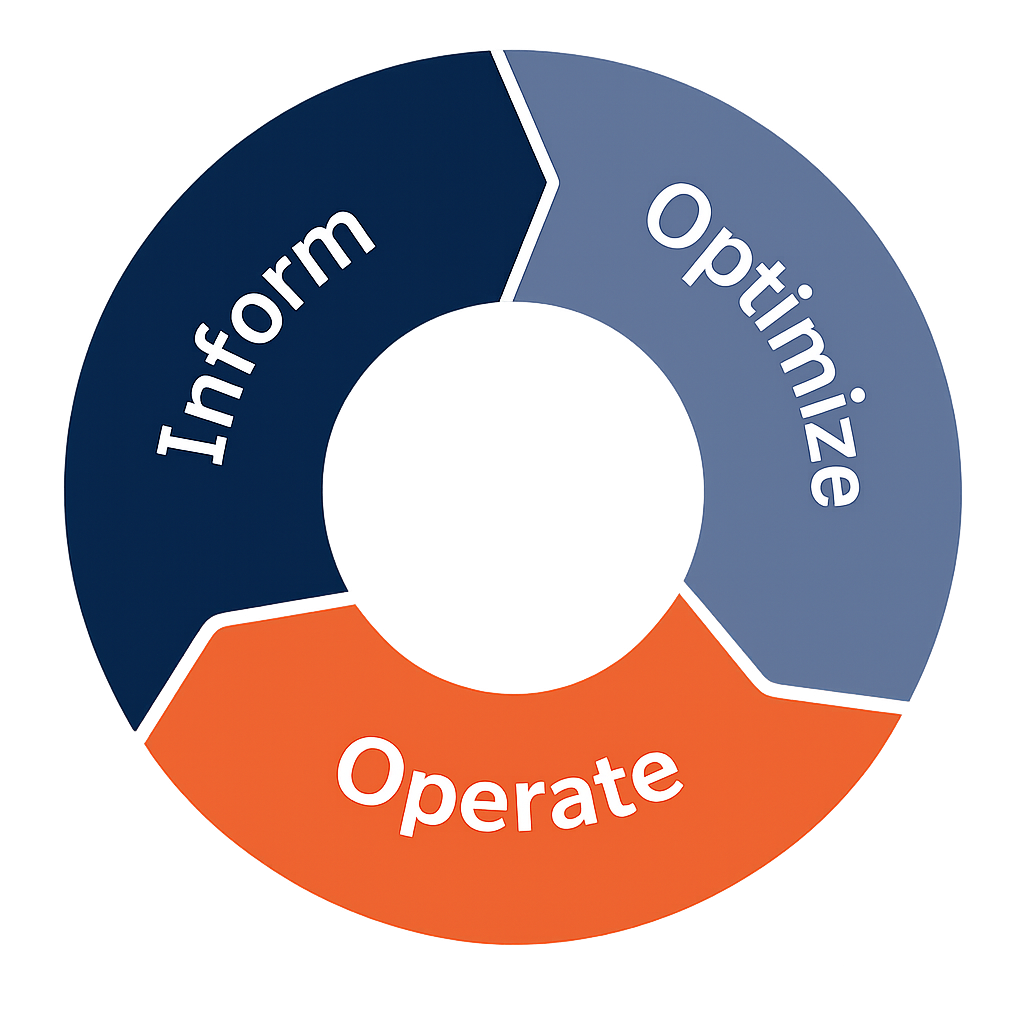


Inform:

We build a foundation of accurate data and insights. This includes:
  • Analysing Cloud, SaaS and licensing usage and costs
  • Allocating spend to teams, products and business owners
  • Creating transparency with dashboards and reporting
  • Introducing forecasting and budgeting

The result is clear visibility and shared understanding of technology spend across the organisation.

Optimize:

We identify and prioritize opportunities to improve efficiency and value, such as:

  • Workload rightsizing and architectural optimization
  • Rate optimization (commitments, reservations and license structures)
  • Elimination of waste and unused resources.

Optimisation is always linked to business context, ensuring that cost reductions do not compromise performance or innovation.

Operate:

We ensure that improvements are implemented and maintained:

  • Embedding FinOps practices in daily operations
  • Establishing governance, policies, and accountability structures
  • Creating a continuous improvement cadence across teams

This phase transforms FinOps from a one-time initiative into organizational change with lasting results.

FinOps at YaWorks


YaWorks engagements are designed to be practical: establish trustworthy data, create accountability, capture optimisation opportunities, and introduce an operating model to maintain savings. We combine technical expertise with financial and operational insight to embed FinOps as a sustainable organisational capability. This means identifying opportunities and ensuring they are implemented, governed, and continuously improved.

The organisation gains capable teams in control of costs: Engineering teams implement cloud cost optimizations. Finance leads an effective technology budgeting process based on Cloud, SaaS and licensing forecasts. Executive leadership has insight into technology spend and confidence to reallocate it to new strategic initiatives. Procurement has long term visibility to effectively negotiate multi-year contracts with Cloud or SaaS suppliers.

Our engagements deliver tangible outcomes:

  • Reduction of avoidable Cloud and SaaS spend through targeted optimisation
  • Allocation of technology costs to business owners, creating accountability
  • Forecasting accuracy to support budgeting and planning
  • Real-time visibility of technology spend for fast and data-driven decision making
  • The ability to reinvest savings into innovation and strategic initiatives

Whether your organisation is scaling in the Cloud or seeking more financial control over technology spend, YaWorks can help you establish a FinOps capability that delivers lasting value.

Successful digital transformation is not measured by how much cloud you consume, but by how effectively technology investments create business value. FinOps provides the governance framework to ensure innovation and accountability grow together.

Source: The Yaworks Finops Playbook is based on the Finops.org framework: https://www.finops.org/framework/phases/


    Martijn Siereveld Cloud Transformation Lead